
Learning to drive is demanding enough on a clear, sunny day. Add heavy rain or thick fog, and it can feel like the road has changed into something completely different. New drivers worry about not seeing far enough ahead, misjudging stopping distances on wet roads, or using the wrong lights and confusing other drivers. Parents feel that tension too when they’re in the passenger seat beside a teen.
At Jungle Driving School, our instructors teach students how to respond when rain, fog, and other changing road conditions affect visibility and traction. We see the same worries turn into calm, repeatable habits.
This guide shares those habits: how to adjust speed and following distance in the rain, how to brake and steer to reduce the risk of skids and hydroplaning, how to use headlights and fog lights so you’re easier to see without blinding anyone, and what to do in thick fog when you can barely see the lane lines.
Because driving laws and requirements vary by state, use this driving guide alongside your state driver’s manual and applicable local laws.
Why Are Rain and Fog So Risky for New Drivers?
Rain and fog present significant challenges for new drivers because they drastically reduce traction and visibility precisely when a driver’s judgment and “feel” for the vehicle are still developing. Rain impacts the grip of the tires, increasing stopping distances on wet roads. Fog and heavy rain hinder how far ahead you can see, making it harder to identify hazards and react in time. This mix of reduced traction, impaired visibility, and lack of experience quickly reduces the margin for error.
In wet weather conditions, large puddles can cause hydroplaning, while glare from oncoming headlights or high beams can further obscure vision. New drivers might continue driving at speeds that seemed appropriate moments ago, but are now too high given the limited visibility and the slick surface of wet pavement.
Traffic can become unpredictable, and heavy storms, whether in spring or summer, may develop suddenly, catching drivers off guard. Despite these challenges, new drivers don’t need to memorize a litany of rules.
Instead, they should focus on a few effective habits:
- Adjusting speed and following distances
- Using headlights appropriately (favoring low beams over high beams in fog or heavy rain)
- Relying on tools like windshield wipers to maintain visibility
Adhering to defensive driving principles and employing wet-weather driving tips, such as checking tire tread depth and avoiding the use of cruise control on slippery roads, can significantly enhance safety. Simple actions, attentive use of lights, and prudent control can help new drivers navigate and manage challenging weather conditions effectively.
The Hidden Physics of Heavy Rain: Traction, Water, and Hydroplaning
Driving in heavy rain presents unique challenges as your vehicle’s tires constantly struggle against a thin film of water on wet roads. At sensible speeds with healthy tread depth, the tire’s grooves can effectively channel water away. However, as speed increases or tire tread wears down, a wedge of water may form under the tires, lifting them slightly off the wet pavement and leading to hydroplaning.
The first signs of this can be subtle. You may notice the steering feels light or vague, and the vehicle can start to wander or feel less connected to the road. If you continue driving at high speeds or make sudden movements, loss of traction can occur rapidly, increasing the risk of accidents.
To enhance safety and maintain control while driving in the rain, consider the following wet-weather driving tips:
- Look After Your Tires: Ensure tread depth is in good condition and tire pressure adheres to your vehicle’s owner’s manual specifications.
- Slow Down Before the Worst of the Rain: Reduce speed early when the rain intensifies, or you notice standing water on the road.
- Be Cautious on Low-Grip Surfaces: Avoid driving over painted lines, metal covers, wet leaves, and deep puddles. These can significantly reduce traction.
By understanding the physics of heavy rain, managing your tires, adjusting your speed, and avoiding abrupt maneuvers on slick surfaces, you can enhance your vehicle’s stability and reduce the likelihood of hydroplaning. Keep visibility clear with windshield wipers and use headlights wisely to improve reaction time and maintain a safe stopping distance.
The SEE–SLOW–SOFT Routine for Heavy Rain Driving
SEE–SLOW–SOFT gives your driver one simple mental script instead of a dozen separate rules: look farther ahead, slow down as visibility and grip drop, and keep all steering and braking smooth. It turns “I’m not sure what to do” into a clear, repeatable routine you can coach at home.
SEE: Look Farther Ahead
In the rain, you must look farther ahead and scan wider. Watch brake lights several cars up, not just the one in front. Notice the size of the spray coming off the tires; more spray can mean more water on the road. Keep checking mirrors so you know who is behind and beside you if you need extra room.
SLOW: Adjust Speed to the Conditions
Treat the speed limit as a ceiling, not a target. As rain gets heavier or visibility drops, ease off early and bring speed down smoothly. A useful rule is simple: if you cannot comfortably stop within the space you can see, you are going too fast for the conditions.
SOFT: Keep Your Inputs Smooth
On wet roads, sudden moves are what get new drivers into trouble. Press the brake pedal smoothly instead of stabbing at it. Turn the steering wheel in gentle arcs, not sharp jerks. If the car begins to hydroplane, stay calm, ease off the accelerator, avoid sudden braking or steering, and allow the tires to regain contact with the pavement.
SEE–SLOW–SOFT is something you and your teen can discuss before a drive (“What will SEE look like tonight?”) and rehearse with an instructor or during appropriate supervised practice until it feels natural.
Heavy Rain Playbook: Speed, Space, Braking, and Road Hazards
In heavy rain, the goal is simple: give yourself more time and more road by lowering speed, increasing following distance, and braking earlier and more gently. That extra margin turns surprises into situations your driver has more time to handle without panic.
At Jungle Driving School, that extra space supports what we call your Survival Zone: the usable space around your vehicle that gives you time to see, decide, and respond before a developing hazard becomes urgent. As visibility and traction decrease, protecting that space becomes even more important.
Increase Your Following Distance
On a dry day, you might be taught a three-second gap. In heavy rain, increase that distance to give yourself more time to respond. Four seconds may be appropriate in moderate rain, while heavier rain, standing water, or poor visibility may require more space. Always adjust for the conditions and follow the guidance in your state driver’s manual.
To measure, pick a sign or post; when the car ahead passes it, start counting “one-thousand-one, one-thousand-two…” Your front bumper should not reach that marker until you hit your target number.
Here’s a quick comparison to help you and your teen picture the change:
| Condition | Following Distance | Braking Style |
| Dry, clear | Typical recommended gap | Normal, firm if needed |
| Heavy rain | Increase as conditions worsen | Earlier, smooth, gentle |
Brake Earlier and More Smoothly
Because you have a longer gap, you can brake earlier and more gently. Begin easing off the accelerator sooner than you think you need to when you see brake lights, a red light ahead, or a tight curve. Let the car’s weight settle naturally rather than transferring it suddenly to the front tires.
Watch for Low-Grip Road Hazards
As you scan, treat certain surfaces as special hazards:
- Wide puddles across most of a lane can hide deep water and trigger hydroplaning.
- Shiny, worn wheel tracks often hold standing water, especially on rutted roads.
- Large patches of wet leaves can reduce traction under the tires.
- Painted arrows, symbols, and crosswalks can become more slippery than bare asphalt when wet.
When you can, coach your driver to steer so each tire path goes around the worst of these while still staying centered in the lane. You want them choosing where the tires run, not just vaguely “staying in the lane.”
Check the Vehicle Before a Rainy Drive
A simple pre-trip habit also pays off. Before a rainy drive, check that:
- Wipers clear the glass cleanly without smearing.
- Headlights and taillights work and are turned on when required or when visibility is reduced.
- Defogger and rear-window defroster clear moisture from the windows quickly.
New drivers are far more confident when they know the car is ready before the sky opens. Parents can also ask their teen’s instructor how adverse-weather skills are taught and which habits should be reinforced during supervised practice.
If conditions become unsafe, the right decision may be to delay the drive, change the route, or stop somewhere safe.
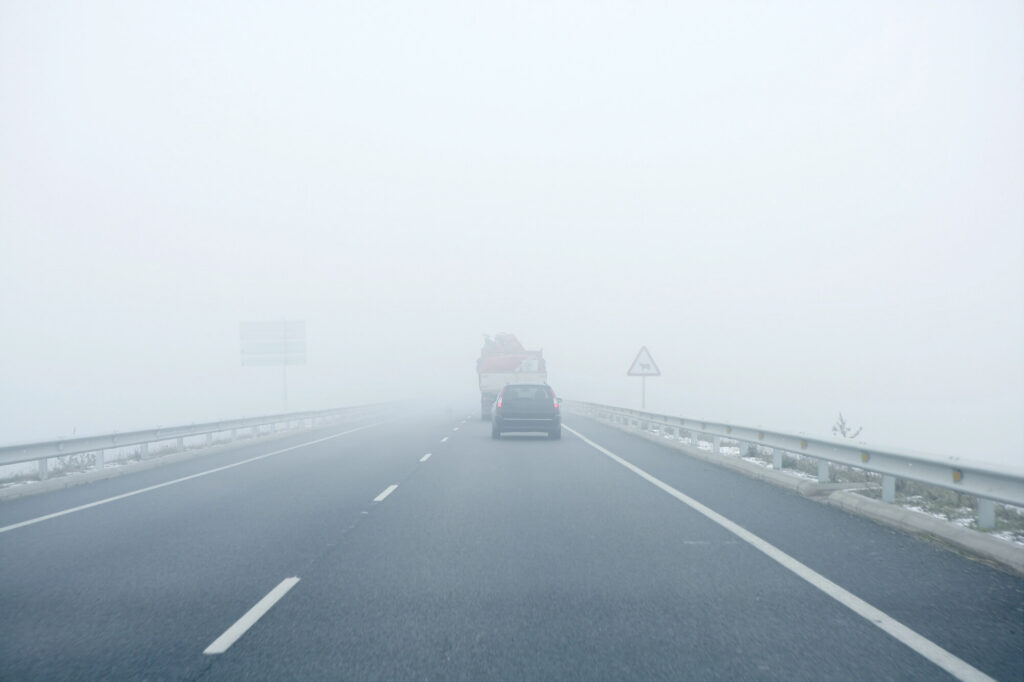
Driving in Fog Tips: How Can New Drivers Stay Safe When They Can’t Trust What They See?
Driving in fog presents unique challenges, especially for new drivers, as it reduces visibility and distorts perception of speed and distance. This can lead to situations where drivers may inadvertently travel faster than is safe, reducing reaction time when encountering traffic or obstacles.
Start With the Core Fog Driving Tips
Essential driving in fog tips include:
- Slow down as visibility decreases to maintain control.
- Increase your following distance to ensure a safe stopping distance and enhance your survival zone.
- Use low-beam headlights, not high beams, to minimize glare.
- Keep windows clear using defoggers and proper climate control settings.
- Avoid unnecessary lane changes and passing.
- Drive at a speed that matches your visible stopping distance to maintain safety.
Why Fog Changes What You See
In foggy conditions, tiny water droplets scatter light, altering the appearance of objects and obscuring visibility. This causes distant objects to fade and bright points, such as lights, to appear as fuzzy blobs. Headlight beams can bounce back, creating a “white wall” effect, making speed and distance difficult to judge accurately.
For new drivers, this can prompt driving at speeds unsuitable for current weather conditions or maintaining too close a distance to the vehicle ahead because tail lights are the only visible reference. The fundamental rule while driving in fog is to ensure you can stop safely within your visible distance.
Know When Conditions Call for a Different Plan
Fog often collects in particular types of locations:
- Low-lying areas
- Near rivers or lakes
- Open fields, especially at night
- Elevated routes where clouds meet the road
If your regular path includes these areas and fog is forecasted, consider planning an alternate route, leaving earlier, or delaying travel to avoid the most severe conditions. Incorporating these strategies enhances both safety and control during your drive in foggy weather.
The LOCATE–LIGHT–LANE Routine for Driving in Fog
LOCATE–LIGHT–LANE is a three-step routine you can use whenever fog rolls in: lock onto stable visual guides, pick the right lights, and hold a calm, predictable lane position. It gives your driver one simple script to fall back on when the outside world turns into a blur.
LOCATE: Use Stable Visual References
LOCATE means choosing solid visual references and sticking with them. Instead of staring into the bright gray blur straight ahead, guide your eyes along lane markings, the right-hand edge line where appropriate, reflective posts, or other stable roadway references.
This helps you hold a steady path without chasing the taillights of the car in front, which can lead you into their mistakes or tempt you to follow too closely.
LIGHT: Choose the Right Beams
LIGHT is about using the right beams. In fog, use low beams, not high beams. High beams throw more light straight ahead, which can bounce back off the droplets and make it harder to see. Low beams put useful light down on the road where you need it.
If your car has fog lights, use them according to your vehicle manufacturer’s guidance and applicable state law. Rear fog lights can be uncomfortable to follow, so switch them off as soon as conditions improve.
LANE: Keep Your Position Predictable
LANE is about calm, predictable positioning. Pick a safe lane and stay there; avoid last-second lane changes or unnecessary passing.
Keep all your glass clear by using the defogger, climate control, and rear-window defroster. Clear windows plus solid reference lines make it much easier to stay oriented when the world outside feels blurred.
For quick recall:
- LOCATE – Use lane markings, edge lines, and reflective posts as your guides.
- LIGHT – Use low beams; use fog lights only when appropriate.
- LANE – Choose a safe lane, keep windows clear, and hold a steady path.
Review LOCATE–LIGHT–LANE before fog develops, so the routine is already familiar if visibility changes during a drive. New drivers should not deliberately seek out dense fog for practice. When visibility becomes too limited for safe driving, delaying the trip or stopping in an appropriate safe location is part of good judgment.
How Should You Use Headlights, Fog Lights, and High Beams in Bad Weather?
In rain and fog, you stay safest by turning low-beam headlights on when visibility is reduced, avoiding high beams that bounce back as glare, and using fog lights only when appropriate. Those three habits make your car easier to see without making conditions harder for anyone else.
Low Beams: Your Default for Reduced Visibility
In reduced visibility, heavy rain, mist, dawn, dusk, or fog, turn your low-beam headlights on when appropriate and whenever required by law. This is about being seen as much as seeing.
Daytime running lights on some cars only light the front; turning on your regular headlights may also activate your rear lights, which matters if spray or fog hides you from drivers behind. Because vehicle lighting systems vary, drivers should know how the controls in their own vehicle work.
Avoid High Beams in Fog and Heavy Rain
High beams have their place on dark roads in clear conditions, but avoid them in fog and use caution with them in very heavy rain. In those conditions, the extra light can reflect back toward you, creating glare and reducing how far you can see.
If you meet someone coming toward you who forgets to lower their high beams:
- Avoid looking directly at the lights.
- Slow down if necessary.
- Shift your gaze toward the right-hand side of your lane while keeping the roadway ahead in view.
- Leave additional space for any vehicle in front.
Fog Lights: Use Them for the Conditions They’re Designed For
Fog lights are designed to provide additional illumination in reduced visibility. Use them when appropriate for the conditions and according to your vehicle’s manual and applicable state law.
Rear fog lights are powerful and can be uncomfortable to follow, so switch them off when they are no longer needed.
These small lighting habits make a big difference in how visible you are and how calmly you can respond when the weather changes.
Build Real-World Driving Skills With Jungle Driving School
Driving in heavy rain and fog becomes more manageable when a new driver has repeatable habits instead of waiting for a hazard to force a reaction.
Remember the two routines:
- SEE–SLOW–SOFT for rain: Look farther ahead, reduce speed as conditions worsen, and keep steering and braking smoothly.
- LOCATE–LIGHT–LANE for fog: Use stable visual references, choose the right lights, and maintain a predictable lane position.
Both support the Jungle Cat mindset: calm alertness, early hazard recognition, deliberate control, and enough space to respond.
That is the focus of the Jungle Way. Jungle Driving School helps teens build real-world driving habits through structured coaching, hazard awareness, space management, and practical decision-making, not just test preparation.
Parents stay part of the process, with clear expectations and skills they can reinforce between lessons. When your teen is ready to build safer, more confident driving habits, find a Jungle Driving School location near you and take the next step.