
A breakdown or sudden problem on the road never arrives at a convenient moment. One minute you are thinking about work or school, the next your dashboard lights up, the engine dies, or the steering suddenly feels wrong.
In those first few seconds, what you do matters as much as what went wrong under the hood.
These roadside emergency tips can help teen drivers, parents, and everyday commuters make safer decisions when a breakdown, flat tire, warning light, nasty road conditions, or sudden vehicle problem interrupts the trip.
By the end of this guide, you will know how to pull over safely, protect your passengers, and handle common roadside problems without panicking.
Why Roadside Emergencies Are Not Just “Bad Luck”
Roadside emergencies are dangerous because the biggest risk often comes after the first problem.
A stalled car, flat tire, or sudden mechanical failures can quickly become a secondary collision if the vehicle is hard to see or stuck near moving traffic.
Common high-risk situations include:
- A car in front stopped partly in a dark lane at night or during inclement weather
- A flat tire on a blind curve
- A stalled vehicle on a narrow shoulder
The good news: roadside safety is trainable.
When drivers practice how to position the car, protect passengers, store the right emergency preparedness kit, and signal other road users, they are less likely to improvise under pressure.
What Should You Do First in a Roadside Emergency?
In any roadside emergency, think in three words: signal, move, protect.
When something goes wrong on the road, you do not need a long checklist; you need those three simple moves you can remember under stress:
- Signal and slow: As soon as you realize something is wrong, put on your hazard warning lights or emergency flashers. Keep a firm grip on the wheel, avoid sudden swerves, and ease off the accelerator so you slow down smoothly. This gives drivers behind you time to react and adapt to changing road conditions.
- Move out of traffic if you can: If the vehicle is still rolling, steer calmly toward the safest available place: a wide roadway shoulder, a safe pull-off area, an exit, a side street, or a parking lot. Avoid stopping in the middle of traffic lanes unless you have no choice, like in the case of a mechanical failure or a flat tire.
- Protect people before property: Once stopped, set the parking brake and think about safety first. Decide whether it is safer to stay belted inside or to exit on the side away from traffic and move to a safe spot. Use road flares or reflective triangles to alert other motorists if you have them in your car emergency kit. If you carry one, put on your rain poncho when it rains.
Once everyone is safe and the car is in a secure place, you can call for roadside assistance service instead of trying to fix risky problems like a dead battery or overheated engine in the middle of a traffic lane.
You can use your flashlight to increase visibility if it is dark.
Teach this three-move script to your teen, partner, or team until they can repeat it without thinking.
In a quiet parking lot or driveway, practice using your emergency preparedness kit with items like jumper cables, a first aid kit, and bottled water. Rehearse safe pull-offs, hazard light use, and clear passenger instructions so the routine feels familiar.
This is where roadside emergency tips become real driving habits instead of ideas someone tries to remember during a crisis.
How To Pull Over And Position Safely on Any Road
Safe roadside positioning looks different on a freeway than it does on a neighborhood street.
On highways and high-speed roads
- Aim for the right shoulder, a safe pull-off area, or the next exit if the vehicle is still controllable. If the shoulder is extremely narrow and you can safely reach a wider area a bit farther ahead, it is often safer to keep rolling to that spot.
- Once stopped, turn your wheels slightly away from traffic and keep your hazard flashing lights on.
- On a narrow shoulder with fast traffic close by, it is often safer to stay belted inside the vehicle and call for help than to stand beside the car.
- If there is a barrier and you can safely exit on the passenger side, move everyone behind the barrier and up the embankment, not along the edge of the road.
Always follow local laws and any instructions from law enforcement, be it police, highway patrol, or emergency services, even if that means doing something different from what you practiced.
On city and suburban streets
- At lower speeds, it may be safer to roll slowly to a side street, parking area, or lot instead of stopping where you are.
- Try not to block intersections, bike lanes, crosswalks, or driveways unless you truly cannot move.
- Use your hazard lights so other drivers understand that you are stopped for a reason, not just parked badly.
- Once you are safely off the main flow, make any calls for help from a parking lot or side street, not from the middle of traffic.
Here is a quick comparison of highway versus city positioning:
| Road type | Safer place to stop | People positioning |
| Highways and high-speed roads | Right shoulder, safe pull-off area, or next safe exit | Often safer inside with a seat belt; if exiting, move behind a barrier away from traffic |
| City and suburban streets | Side street, parking area, or lot away from the main flow | Exit on the sidewalk side and move to a sidewalk or clearly safe area |
Exact rules about stopping locations, hazard light use, and warning devices vary by state and local area, so treat this section as general guidance and follow local law first.
Whatever the road type, avoid standing in front of or behind your vehicle in the traffic lane. If another car hits yours, those are the most dangerous places to be.
The Roadside Emergency Kit Checklist
A good roadside emergency kit helps you do three things: stay visible, handle minor car problems only when it is safe, and keep passengers comfortable while help is on the way.
You do not need a trunk full of gear. Start with a small, organized car emergency kit you can reach without digging through the car.
Roadway safety guidance from the National Highway Traffic Safety Administration (NHTSA) and many state transportation agencies commonly recommends keeping visibility gear, warning devices, basic vehicle tools, and emergency first aid supplies in your vehicle.
Build your roadside emergency supply kit around these essentials:
Visibility and warning items
- Reflective orange triangles or LED beacons
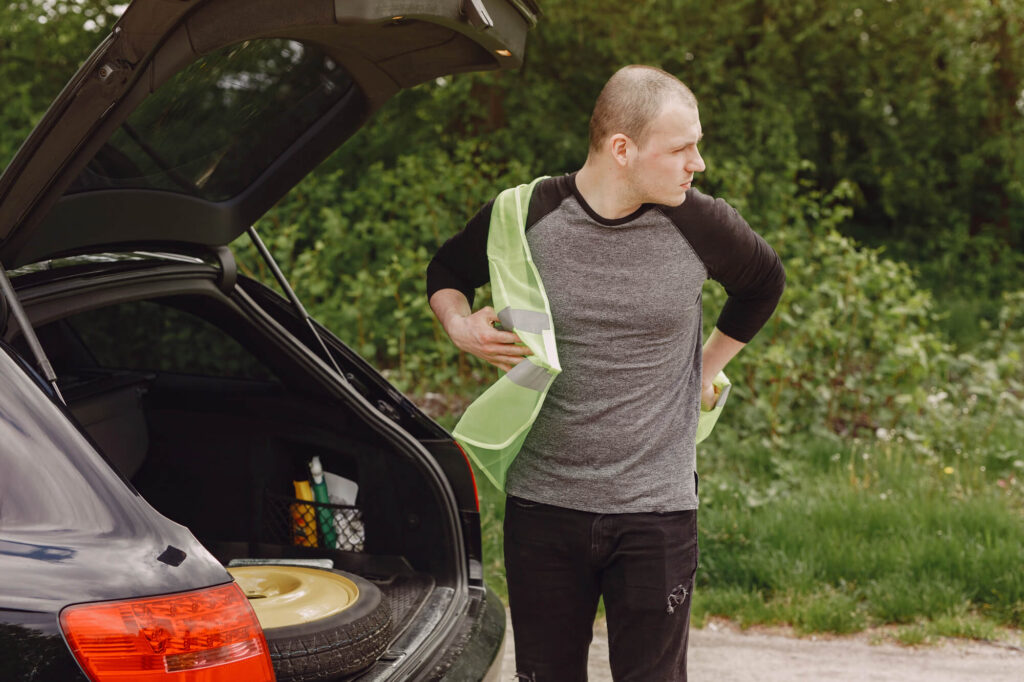
- High-visibility vest for any adult who may need to step outside
- Working flashlight with extra batteries
- Road flares for increased visibility
Basic vehicle tools
- Properly inflated spare tire or approved tire repair kit for flat tire emergencies
- Jack and lug wrench
- Jumper cables or a small jump-starter pack to tackle battery issues
- Basic multi-tool or small toolkit for minor mechanical failures
Passenger comfort and safety supplies
- Bottled water and shelf-stable snacks
- Basic first-aid kit for minor injuries
- Safety blanket or warm layers in cold regions
- Ice scrapers during winter in areas where snow and ice are common
- Sun protection and extra water in hot climates
- Notepad with a paper checklist, including emergency phone numbers
Not every car has the same amount of space, so these are meant to be the bare minimum essentials for any emergency car kit. If you have the room, you can add a fire extinguisher (although never use it if your vehicle is already engulfed in flames), portable chargers, Mylar sleeping bags, and possibly an emergency radio.
Keep the kit in the same reachable place every time, ideally near the top of the trunk or cargo area. Check it twice a year, such as during a regular vehicle service appointment or daylight saving time change, so batteries, water, and food stay current.
One safety rule matters more than the kit itself: never use tools, jacks, or tire repair equipment if doing so would put you close to moving traffic.
If the roadside scene is not safe, focus on visibility, passenger safety, and calling for roadside assistance.
Tire Blowouts and Flats: Calm, Step-by-Step
A sudden tire failure, especially at highway speed, feels violent and frightening, but the safest response is simple and controlled.
Your goal is to keep the vehicle pointed straight, let speed bleed off gradually, and only then steer toward a safe place to stop. Once you are off the road, you decide whether to change the tire based on space, visibility, and traffic, not just whether you own a jack.
If a tire blows out while you are driving
- Hold the steering wheel firmly with both hands and keep the vehicle pointed straight.
- Do not slam on the brakes. Let the car slow as you gently ease off the accelerator.
- Once speed has dropped and the car feels stable, signal and steer smoothly toward a safe stopping place off the road.
- When stopped, apply the parking brake, switch on hazards if they are not already on, and only get out when you have checked that it is safe to do so on the side away from traffic.
Always follow local law and any instructions from police, highway patrol, or emergency services at the scene.
Deciding whether to change the tire
Never attempt a roadside repair if doing so would place you near moving traffic, on unstable ground, or in a spot where other drivers may not see you in time.
Only change a tire yourself if both the ground and the traffic environment are safe.
In practice, that means:
- You are on firm, level ground.
- You can get well away from traffic, with plenty of space around the vehicle.
- Weather and visibility are good, and other drivers can clearly see you.
On any road where traffic is moving fast and closely, assume you will not change the tire yourself.
Treat the vehicle as something to wait inside with seat belts on, or move away from entirely, until professionals can create a safe work zone. If you are on a narrow shoulder, near a bend, in heavy traffic, or in poor visibility, it is usually safer to stay in the vehicle, call for roadside assistance, and wait for help.
Many newer vehicles carry a sealant-and-compressor repair kit instead of a full-size spare, so check what your car has and read the instructions before you ever need it. Whatever you choose, reduce your chance of a blowout by making tire checks, pressure, tread wear, cracks, and bulges a regular habit.
How Should You Manage Passengers, Kids, and Pets in a Roadside Emergency?
In many roadside emergencies, the real challenge is not the car, but the people and animals inside it.
Young children may want to unbuckle and step out, teens may want to “help” in unsafe ways, and pets can panic or bolt toward traffic.
If you agree on simple roles and language in advance, you can keep everyone calm and contained while you deal with the vehicle and phone calls.
- Agree on roles in advance: One adult or responsible older teen supervises children and pets while the driver handles the vehicle, phone calls, and traffic.
- Brief passengers quickly: Use plain language: “Stay buckled. When I say so, we’ll get out on this side and walk to that safe spot.” Very young children should stay buckled until there is a clearly safe exit on the side away from traffic.
- Keep children close and calm: Hold hands, use simple, reassuring phrases you have practiced before, and keep everyone together in a safe area.
- Secure pets early: Use a leash, harness, or crate so they cannot bolt into the road or distract you during a critical decision.
- Keep everyone away from crush zones: Do not let anyone stand between your car and another vehicle, a guardrail, or a barrier in case your vehicle is hit.
- Discourage “directing traffic”: Older kids and teens should keep phones ready to call for help if asked, but they should not step into the road to wave at drivers unless authorities specifically tell them to.
Practicing these roles in a parking lot or driveway can make a huge difference when real pressure hits, and gives your teen a clear script instead of guessing what to do.
A Simple Roadside Scene Management Framework
In almost any roadside emergency, staying calm is essential, and you can think in three layers: protect people, make the scene visible and predictable, and hand over to professionals. That simple mental framework matches what emergency services and roadside assistance teams try to do every day, and it reinforces the same people before property idea you use in your first three moves. Regular vehicle maintenance can reduce the risk of breakdowns significantly, and keeping an emergency kit included in every vehicle for roadside assistance — stocked with bottled water changed yearly, a tire pressure gauge, warning devices such as flares or reflective triangles, and organized in a heavy-duty nylon bag for quick access — means you are prepared before the situation demands it.
- Protect people: Hazard lights should be activated immediately after a breakdown occurs, followed by seat belts confirmed, a safe stopping position secured, clear instructions given to passengers, and decisions made about staying in or getting out. In case of smoke or fire, passengers should evacuate immediately, and if you must exit on a busy road, exit your vehicle through the passenger door if necessary to stay away from live traffic lanes. Keep doors locked while waiting for assistance once the vehicle is safely stopped and passengers are accounted for.
- Make the scene visible and predictable: Hazards on, lights as appropriate, and warning devices such as flares or reflective triangles placed well behind the vehicle so drivers can see them in time, not right next to your bumper. Drivers should note their surroundings including landmarks, road names, and direction of travel to assist emergency services when help is called.
- Hand over to professionals: When in doubt, call roadside assistance, your insurance company’s roadside assistance line, or emergency services. Describe your location as clearly as you can, including landmarks, direction of travel, and lane, and then follow their instructions. Do not try to stand in the road and direct traffic unless police or highway personnel explicitly ask you to.
For parents, driving instructors, and families with new drivers, this three-layer framework is easy to teach, practice, and test. Short in-car drills such as practicing safe pull-offs, hazard light use, and talking through protect, visible, professionals in a quiet area help these layers become reflexes rather than theory.
How to Practice These Roadside Skills Before You Need Them
Reading about roadside procedures is helpful. Real confidence comes from turning them into muscle memory. The goal is to make signal, move, protect and your scene-management framework feel as automatic as checking your mirrors or buckling a seat belt, so your family does not have to invent a plan in the middle of a crisis. Check your spare tire every 6 months for inflation and keep a tire pressure gauge in your emergency kit alongside bottled water changed yearly and warning devices organized in a heavy-duty nylon bag so the kit is ready when it matters. Drivers should aim to pull over safely during a vehicle breakdown by identifying safe stopping positions on your regular commute before an emergency forces the decision under pressure.
You can keep practice simple and low-stress:
- Short what would you do conversations in the driveway covering scenarios like smoke, a flat tire, or a breakdown on a busy road
- Slow-speed pull-off drills in an empty parking lot, practicing safe positioning and hazard light activation immediately on stopping
- Quick reviews of where you would safely stop on your regular commute, including noting landmarks that would help emergency services find you
- Involve your teen in packing and checking the emergency kit, confirming bottled water, spare tire inflation, tire pressure gauge, and warning devices are all present and serviceable
- Talk about when you would wait for professionals instead of trying to fix something alone, and when to exit through the passenger door or evacuate immediately
That kind of rehearsal fits the Jungle Way: build awareness, stay adaptable, and make safer decisions before the road gets unpredictable.
Practice Roadside Safety Before You Need It
If you want your teen, or yourself, to stay calm under pressure, choose safer options, and work smoothly with emergency services when something goes wrong, pair these roadside emergency tips with real guided practice. A strong driving education program weaves safe pull-offs, hazard light use, passenger management, emergency kit preparation, and basic roadside decision-making into everyday lessons so new drivers learn to protect people, not just operate a car. Regular vehicle maintenance can reduce the risk of breakdowns, and building the habit of checking spare tire inflation every 6 months and keeping a fully stocked emergency kit in every vehicle means fewer roadside crises and better outcomes when they do occur.
When you are ready for those skills to feel natural instead of theoretical, find a nearby Jungle Driving School location and turn today’s reading into tomorrow’s reflexes.